
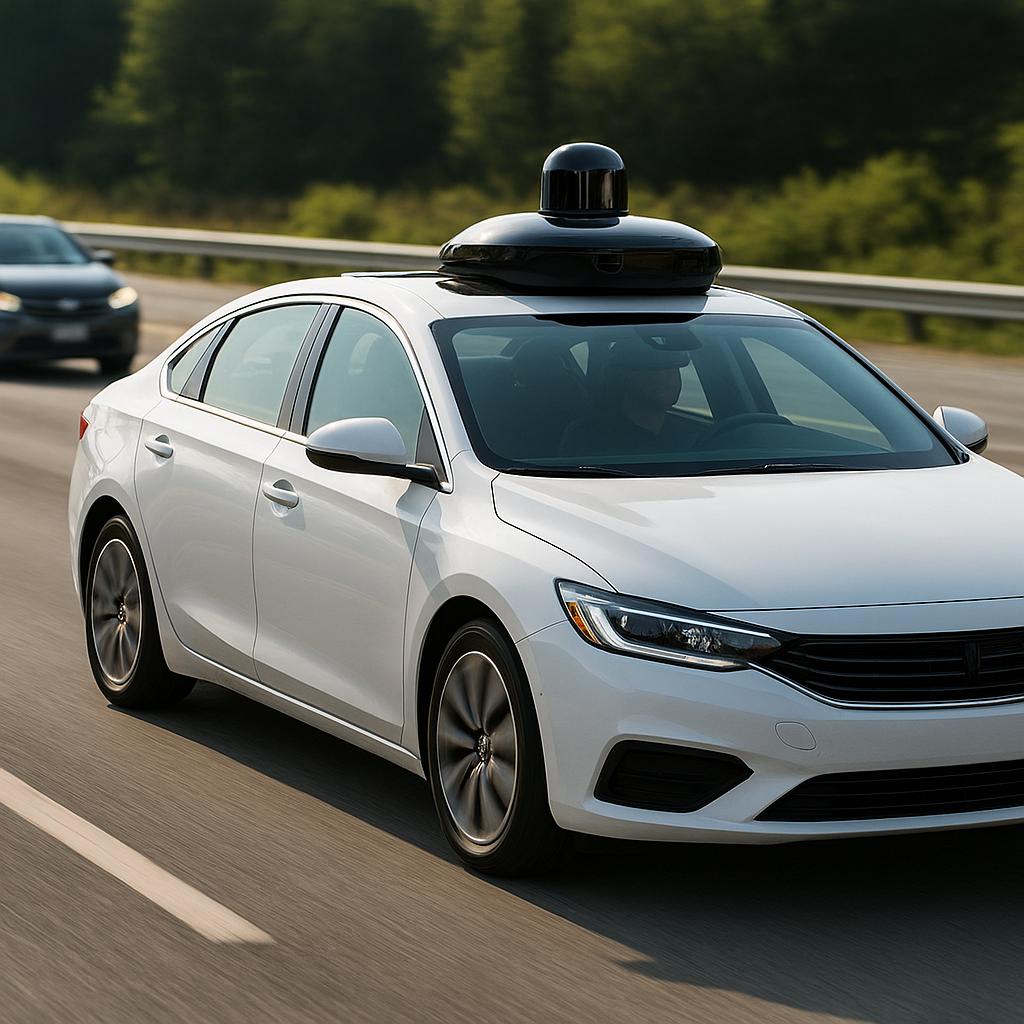
Self-driving cars could significantly reduce traffic accidents, and recent research suggests that some autonomous vehicles already crash less often than human drivers. A 2026 study by the Insurance Institute for Highway Safety (IIHS) found that Waymo’s driverless vehicles had 68% fewer police-reportable crashes per mile than human-driven cars in comparable locations. However, these results apply to specific autonomous systems operating under defined conditions, not every self-driving car.
Autonomous driving technology has the potential to eliminate several common causes of crashes, including distracted driving and fatigue. But software errors, unpredictable road situations, and environmental limitations mean that self-driving cars cannot prevent every accident.
Can Self-Driving Cars Actually Reduce Accidents?
Fully autonomous vehicles could improve road safety because they do not experience many of the limitations that affect human drivers. Their onboard systems continuously analyze traffic conditions and make driving decisions based on information collected by cameras, radar, and other sensors.
Several characteristics give autonomous vehicles potential safety advantages:
- No driver fatigue. Automated systems do not become sleepy or lose concentration after spending hours on the road.
- No alcohol impairment. Autonomous driving software cannot become intoxicated, eliminating this particular source of human driving errors.
- Continuous monitoring. Sensors track surrounding vehicles, pedestrians, cyclists, and obstacles without the distractions associated with human attention.
- Automatic hazard detection. Autonomous systems can identify potential collision risks and initiate braking or steering responses.
- Consistent responses. Software can react quickly to certain detected hazards without the delay involved in human decision-making.
For example, an autonomous vehicle approaching stopped traffic may detect slowing vehicles ahead and begin braking before a collision becomes unavoidable. Unlike a distracted driver, the system does not need to look up from a phone before recognizing the danger.
However, these advantages depend on how accurately the technology interprets its surroundings. An autonomous vehicle can still make an incorrect decision or fail to recognize an unusual hazard.
What Do Self-Driving Car Accident Statistics Show?
Recent studies provide measurable evidence that some driverless vehicles have lower crash rates than conventional cars. Two important findings published in 2026 come from IIHS and autonomous vehicle operator Waymo.
IIHS Research: 68% Fewer Police-Reportable Crashes
In July 2026, the Insurance Institute for Highway Safety published research comparing Waymo robotaxis with human-driven vehicles in Phoenix, San Francisco, Los Angeles, and Austin.
The researchers examined approximately 50 million miles of driverless Waymo operation during the study period and compared crash involvement rates with human drivers traveling in the same cities and years.
According to the 2026 IIHS study, Waymo vehicles experienced 68% fewer crashes per mile that would typically be reported to police.
The researchers adjusted the crash records to account for reporting differences. Autonomous vehicle operators are required to document incidents that ordinary drivers might not report, making direct comparisons potentially misleading without additional analysis.
The findings are encouraging, but they represent Waymo’s performance within its operating areas. They do not establish that every autonomous driving system is safer than human drivers.
Waymo Safety Data: 82% Fewer Injury-Reported Crashes
Waymo’s own safety analysis, updated in September 2026 using data through June, reported an 82% lower rate of crashes involving any reported injury compared with estimated human-driver benchmarks in the same operating areas.
The analysis covered more than 270 million fully autonomous miles across five major metropolitan areas: Phoenix, San Francisco, Los Angeles, Austin, and Atlanta.
According to Waymo’s published safety data, its vehicles were involved in approximately 0.67 injury-reported crashes per million miles, compared with 3.77 for the adjusted human-driver benchmark.
These figures come from the company’s published methodology and should be evaluated with that limitation in mind. They are not directly interchangeable with the IIHS findings because the studies use different crash definitions, observation periods, and comparison methods.
Crash rates per million miles are more informative than raw collision counts because they account for distance traveled. A fleet driving hundreds of millions of miles will naturally have more opportunities for accidents than one operating over a much shorter distance.
Why Can Self-Driving Cars Still Cause Accidents?
Despite promising statistics, autonomous vehicles face technical and environmental challenges that prevent them from guaranteeing accident-free travel.
- Difficult weather conditions. Heavy snow, rain, and fog can interfere with cameras and other sensors. Road markings may also become difficult to identify.
- Unpredictable road users. Pedestrians stepping into traffic, cyclists making sudden turns, and drivers behaving unexpectedly can create complicated situations.
- Software and perception errors. An autonomous system might misidentify an object, misunderstand temporary road layouts, or choose an inappropriate response.
- Limited operating environments. Many driverless services are designed for specific geographic areas and supported conditions rather than unrestricted driving everywhere.
Another important distinction is the difference between fully driverless operation and consumer driver-assistance technology.
Level 2 automation allows a vehicle to control steering and speed simultaneously, but the human driver must continuously supervise the road and remain responsible for driving.
Level 4 automation allows a vehicle to handle driving without constant human supervision, but only within its designated operating conditions.
Waymo robotaxis use Level 4 technology. Consumer systems that provide lane centering and adaptive cruise control generally operate at Level 2 and cannot automatically be considered equivalent.
As explained by the National Highway Traffic Safety Administration, automated driving systems and Level 2 driver-assistance systems have different capabilities and crash-reporting requirements.
Research has demonstrated safety benefits from individual collision-prevention technologies, such as automatic emergency braking. However, IIHS notes that the broader crash-prevention benefits of partial driving automation have not been established to the same degree.
Will Autonomous Cars Make Roads Safer in the Future?
Autonomous vehicles could make roads safer as the technology improves and expands beyond its current operating environments. However, wider deployment must be supported by reliable safety evidence.
Several developments will influence future accident rates:
- Better hazard recognition. Improved software could help vehicles interpret unusual road situations and respond more reliably.
- Greater environmental adaptability. Autonomous systems must demonstrate safe performance across different weather conditions, road types, and traffic environments.
- More extensive real-world testing. Larger driving datasets can help identify rare failures that shorter trials may miss.
- Independent safety evaluation. Consistent reporting standards and independently verified comparisons are essential for measuring actual improvements.
- Gradual deployment. Expanding services into new locations allows performance to be evaluated under increasingly varied conditions.
The 2026 IIHS findings and Waymo’s published statistics show that certain Level 4 autonomous vehicles already achieve substantially lower crash rates than human drivers in their operating areas. Nevertheless, those results cannot guarantee equally strong performance across every city, highway, climate, or autonomous vehicle manufacturer.
So, will self-driving cars reduce accidents? Current evidence suggests they can, and some existing robotaxi services are already demonstrating measurable safety improvements. Yet autonomous driving cannot eliminate all crashes, and its long-term impact on road safety will depend on the reliability of individual systems, their operating conditions, and continued independent evaluation.